Correct-by-Design Blockchain-based Smart Contracts
2017 – 2020

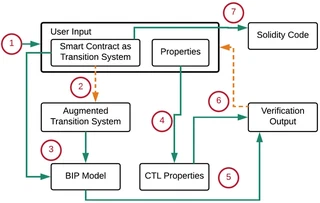
The adoption of blockchain based distributed ledgers is growing fast due to their ability to provide reliability, integrity, and auditability without trusted entities. One of the key capabilities of these emerging platforms is the ability to create self-enforcing smart contracts. However, the development of smart contracts has proven to be error-prone in practice, and as a result, contracts deployed on public platforms are often riddled with security vulnerabilities. This issue is exacerbated by the design of these platforms, which forbids updating contract code and rolling back malicious transactions. In light of this, it is crucial to ensure that a smart contract is secure before deploying it and trusting it with significant amounts of cryptocurrency.
This project introduces a framework for the formal verification of contracts that are specified using a transition-system based model with rigorous operational semantics. Our model-based approach allows developers to reason about and verify contract behavior at a high level of abstraction. Our framework allows the generation of smart-contract code from the verified models, which enables the correct-by-design development of smart contracts.
Team

Aron Laszka is an Associate Professor in the College of Information Sciences and Technology at the Pennsylvania State University, where he directs the Applied Artificial Intelligence Lab. Before joining Penn State in 2022, he was an Assistant Professor at the University of Houston (2017 – 2022), a Research Assistant Professor at Vanderbilt University (2016 – 2017), and a Postdoctoral Scholar at the University of California, Berkeley (2015 – 2016).
His research focuses on machine learning for decision making and optimization, in particular reinforcement learning and learning-augmented combinatorial optimization, with applications in cyber-physical systems, such as transportation and power systems, and in cybersecurity. He is a recipient of the NSF CAREER Award. His research is funded by the National Science Foundation, the Department of Energy, the Department of Transportation, and other agencies.