Cyber-Physical Systems

DeimosBC: A Blockchain-based System for Crowdsensing after Natural Disasters

For first responders entering into a post-disaster situation, there is usually a severe lack of up-to-date ground truth. The initial period of time has multiple sources of …

Raunak Sarbajna
•
AI for Equitable and Resilient Food Distribution during Disasters featured image

AI for Equitable and Resilient Food Distribution during Disasters

Food insecurity is the lack of consistent and reliable access to nutritious food. In the Houston (Texas) area, over 14% of Harris County households experienced food insecurity before the emergence of COVID-19. It is unclear how the nutritional needs of Houston’s vulnerable populations will be served when the next devastating weather event strikes the region, given that the city is already experiencing multiple disasters, including COVID-19, economic disruptions, and systemic food insecurity. The Houston Food Bank (HFB) collaborates with over 1,500 partners to address the needs of families experiencing food insecurity. Through a community-driven approach, this project brings together civic collaborators with university researchers to align HFB’s food distribution strategy to match food insecurity during multiple disaster profiles. Our project will develop indicators of individual and community equity for food distribution during pandemics and extreme weather events; design a network organizational resilience index for food bank networks and interventions to improve network resilience; develop and validate a predictive tool for infrastructure vulnerability, and develop and validate an artificial-intelligence based decision-making tool for determining the locations of food distribution hubs and their food allocation.

Transit-Gym: A Simulation and Evaluation Engine for Analysis of Bus Transit Systems

Public-transit systems face a number of operational challenges: (a) changing ridership patterns requiring optimization of fixed line services, (b) optimizing vehicle-to-trip …

Ruixiao Sun
•
Equitable Electric Mobility: Smart Charging and Smart Parking featured image

Equitable Electric Mobility: Smart Charging and Smart Parking

This Houston-based project establishes a collaborative process with community and commercial technology partners to accelerate the equitable development of accessible fast charging infrastructure and electric vehicle (EV) ownership for low income families by leveraging regional markets of early EV adopters. The novelty of the project lies in a community-driven participatory approach that integrates both social and technical dimensions, bringing transformational change to EV ownership and electrification of smart public transportation. This will be achieved using a data-driven model that integrates real-time data from micro-transit, fixed-route transit, and carpooling services to predict and overcome the uncertainties of traffic conditions, which would result in uncertain travel times and poor reliability.

Efficient Data Management for Intelligent Urban Mobility Systems

Modern intelligent urban mobility applications are underpinned by large-scale, multivariate, spatiotemporal data streams. Working with this data presents unique challenges of data …

Michael Wilbur
•

A Review and Outlook on Energy Consumption Estimation Models for Electric Vehicles

Electric vehicles (EVs) are critical to the transition to a low-carbon transportation system. The successful adoption of EVs heavily depends on energy consumption models that can …

Yuche Chen
•

Minimizing Energy Use of Mixed-Fleet Public Transit for Fixed-Route Service

Affordable public transit services are crucial for communities since they enable residents to access employment, education, and other services. Unfortunately, transit services that …

avatar
Amutheezan Sivagnanam
•

Safe and Private Forward-Trading Platform for Transactive Microgrids

Power grids are evolving at an unprecedented pace due to the rapid growth of distributed energy resources (DER) in communities. These resources are very different from traditional …

Scott Eisele
•

The Role of Blockchains in Multi-Stakeholder Transactive Energy Systems

Power grids are undergoing major changes due to rapid growth in renewable energy and improvements in battery technology. Prompted by the increasing complexity of power systems, …

Scott Eisele
•
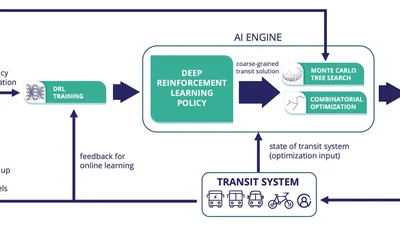
AI-Engine for Optimizing Mixed-Fleet Transit Operations featured image

AI-Engine for Optimizing Mixed-Fleet Transit Operations

In every public transit system, a trade-off has to be made between concentrating service into very useful routes that serve large numbers of people and spreading service out to ensure that people everywhere have access to at least some service. Improving the efficiency of an existing system while enhancing service in terms of both usefulness and coverage presents considerable challenges. These challenges to operational efficiency are exacerbated by the requirement to provide complementary paratransit services, which are typically characterized by very low efficiency (energy per passenger per mile) and attendant high cost of operation. Our vision is to address these challenges by combining the complementary advantages of fixed- and dynamic-route transit services and seamlessly integrating them. We focus on the following objectives: minimizing energy used per passenger per mile, minimizing passenger wait and trip times, maximizing service coverage, and maximizing the percentage of daily trips serviced by transit. To explore this complex decision space, we will design, implement, and evaluate an artificial intelligence engine, which will enable agencies with mixed-vehicle fleets (EVs, ICEVs, etc.) to operate integrated fixed-dynamic transit services that maximize energy efficiency and make transit more accessible.