Cyber-Physical Systems

Rural Transit Solutions for Enhancing Access & Connectivity featured image

Rural Transit Solutions for Enhancing Access & Connectivity

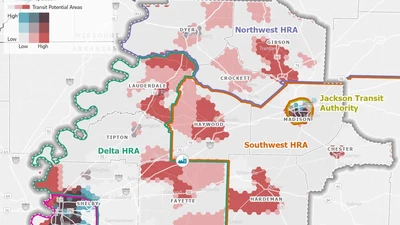
This Civic Innovation Challenge (CIVIC) Stage 1 project will perform research to address transportation challenges faced by residents and workers in rural areas around industrial hubs. Rapid economic growth in these areas demands efficient public transit systems that can serve a geographically dispersed workforce with strict arrival times. However, existing solutions often struggle with these unique requirements, leading to traffic congestion, pollution, and limited access to essential services for residents. This research project will develop and deploy a novel multi-modal transit system for Blue Oval City (BOC), a new rural industrial hub in Stanton, Tennessee. The system will combine fixed-line buses with on-demand micro-transit services, addressing the challenges posed by the geographically dispersed workforce and strict arrival times.
AI-Powered Autonomy-Aware Neighborhood Mobility Zones featured image

AI-Powered Autonomy-Aware Neighborhood Mobility Zones

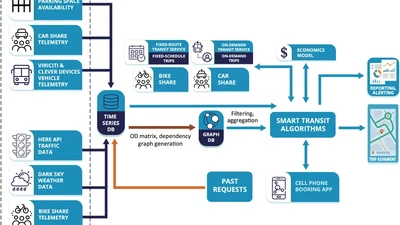
This project reimagines public transportation for mid-sized U.S. cities through an AI-driven, multi-modal mobility framework that integrates fixed-line buses and on-demand microtransit into a single, responsive system. Led by the Chattanooga Area Regional Transportation Authority (CARTA) with technical contribution from the Pennsylvania State University, Vanderbilt University, and Cornell University, this $7 million initiative is designed to enhance infrastructure utilization, mobility access, and financial viability of public transit in Chattanooga while providing a national model for AI-enabled mobility resilience.

Grid-Aware Charging and Operational Optimization for Mixed-Fleet Public Transit

The rapid growth of urban populations and the increasing need for sustainable transportation solutions have prompted a shift towards electric buses in public transit systems. …

Rishav Sen
•

SmartTransit.AI: A Dynamic Paratransit and Microtransit Application

New rideshare and shared mobility services have transformed urban mobility in recent years. Such services have the potential to improve efficiency and reduce costs by allowing …

Sophie Pavia
•

Deploying Mobility-On-Demand for All by Optimizing Paratransit Services

While on-demand ride-sharing services have become popular in recent years, traditional on-demand transit services cannot be used by everyone, e.g., wheelchair-bound people. …

Sophie Pavia
•

Multi-Agent Reinforcement Learning with Hierarchical Coordination for Emergency Responder Stationing

An emergency responder management (ERM) system dispatches responders, such as ambulances, when it receives requests for medical aid. ERM systems can also proactively reposition …

avatar
Amutheezan Sivagnanam
•

Multi-Agent Reinforcement Learning for Assessing False-Data Injection Attacks on Transportation Networks

The increasing reliance of drivers on navigation applications has made transportation networks more susceptible to data-manipulation attacks by malicious actors. Adversaries may …

avatar
Taha Eghtesad
•

Forecasting and Mitigating Disruptions in Public Bus Transit Services

Public transportation systems often suffer from unexpected fluctuations in demand and disruptions, such as mechanical failures and medical emergencies. These fluctuations and …

avatar
Chaeeun Han
•
Best Paper Award

An Online Approach to Solving Public Transit Stationing and Dispatch Problem

Public bus transit systems provide critical transportation services for large sections of modern communities. On-time performance and maintaining the reliable quality of service is …

Jose Paolo Talusan
•

Reinforcement Learning based Proactive Control for Enabling Power Grid Resilience to Wildfire

Industrial electric power grid operation subject to an extreme event requires decision making by human operators under stressful conditions. Decision making using system data …

avatar
Salah Uddin Kadir
•