Data-Driven Energy Optimization for Multi-Modal Transit
Funded in part by the Department of Energy under Award DE-EE0008467


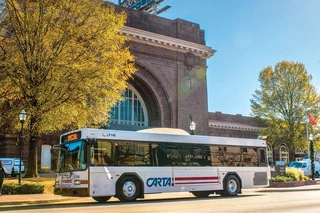
The goal of this project is to develop a high-resolution system-level data capture and analysis framework to revolutionize the operational planning of a regional transportation authority, specifically the Chattanooga Area Regional Transportation Authority (CARTA). There is existing research on improving energy efficiency in transportation networks through analyzing energy consumption data per vehicle type and driving context. However, these studies are based on trip-specific estimation and thus cannot be applied to a regional transportation network. Further, a number of these studies are based on simplified model estimation that is used within a simulation framework for analysis and are therefore difficult to validate during actual driving/road conditions that are not captured in the training dataset (which is typically limited in size and features).
The availability of ubiquitous high-speed networking in Chattanooga provides us with a unique opportunity to change this status quo by providing mechanisms to significantly improve the operational efficiency of fleet operations. Specifically, we collect high-resolution datasets containing all information about engine status, vehicle location, fuel usage, etc. in real-time from CARTA’s fleet of buses, car sharing, and e-bike sharing vehicles and send them to a central station for analysis. Additionally, we get state of charge data from the electric vehicles, which can then be used to estimate vehicle health using data-driven prognostic algorithms developed by the team. Combined with the traffic congestion information obtained from external sources, such as HERE, this data can help create high-resolution energy consumption predictors, contextualized with features such as vehicle types and events in the city. These predictors can then be used by agencies like CARTA for operational optimization.
Overall, this project will enable the development and evaluation of tools to promote energy efficiency within a mobility-as-a-service transportation model in a mid-sized city. In addition to energy efficiency within each specific mode of operation, such as electric bus and electric car, this project will identify network mobility and energy efficiency associated with movement throughout the continuum of transportation choice present within Chattanooga. Further, the proposed project can complement the DoE national labs effort on vehicle energy consumption modeling by exploiting new data to investigate the impacts of road/driver factors on vehicle energy consumption. In addition, the project can supplement DoE national labs efforts by providing more data on electric bus operations under various driving conditions for model validation.
Team

Aron Laszka is an Associate Professor in the College of Information Sciences and Technology at the Pennsylvania State University. Previously, he was an Assistant Professor at the University of Houston, a Research Assistant Professor at Vanderbilt University, and a Postdoctoral Scholar at the University of California, Berkeley.
His research interests revolve around artificial intelligence and cyber-physical systems, focusing on machine learning for decision making and optimization, with applications in smart and connected communities, critical infrastructure, and cybersecurity.
His research is funded by the National Science Foundation, the Department of Energy, the Department of Transportation, and other agencies.

