Addressing Transit Accessibility Challenges due to COVID-19
Funded in part by the National Science Foundation under Award CNS-2029952


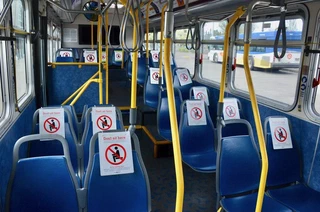
The COVID-19 pandemic has not only disrupted the lives of millions but also created exigent operational and scheduling challenges for public transit agencies. Agencies are struggling to maintain transit accessibility with reduced resources, changing ridership patterns, vehicle capacity constraints due to social distancing, and reduced services due to driver unavailability. A number of transit agencies have also begun to help the local food banks deliver food to shelters, which further strains the available resources if not planned optimally. At the same time, the lack of situational information is creating a challenge for riders who need to understand what seating is available on the vehicles to ensure sufficient distancing. In partnership with the transit agencies of Chattanooga, TN, and Nashville, TN, the proposed research will rapidly develop integrated transit operational optimization algorithms, which will provide proactive scheduling and allocation of vehicles to transit and cargo trips, considering exigent vehicle maintenance requirements (i.e., disinfection). A key component of the research is the design of privacy-preserving camera-based ridership detection methods that can help provide commuters with real-time information on available seats considering social-distancing constraints. The datasets and algorithms developed through this program will be swiftly released to the research community to encourage a wider collaborative effort that will help other transit agencies that face similar challenges.
The intellectual merit of the proposed research lies in the design and evaluation of integrated operational optimization for both fixed-line and on-demand transit (including paratransit) under atypical capacity constraints, which requires maximizing transit access but minimizing contact. The challenge for optimization is the uncertainties that arise due to the atypical travel time and travel demand distribution, both of which need to be learned online again due to the changed scenarios. While it is possible to optimize these transit modes separately as prior work has done, integrated optimization can lead to significantly better results. However, this is difficult as the solution space of these problems is very large. The approach is based on rapidly composing and comparing the effectiveness of principled decision-theoretic approaches such as Monte Carlo tree search, optimal trip assignments using integer programming and problem-specific heuristics, and demand aggregation for on-demand transit. To develop a model for varying travel demand, the research uses novel neural network architectures to estimate usage and seating patterns in real-time from cameras that are already installed within transit vehicles. This will enable transit agencies to obtain travel demand even when they are running fare-free operations to minimize contact with drivers. Working with partner transit agencies, the researchers will be able to make the services more accessible for the community during these challenging times. This project directly relates to Smart and Connected Communities program as it demonstrates the importance of the integration of technical and social research with strong community engagement in improving resilience of transit systems due to pandemics and other crises.
Team

Aron Laszka is an Associate Professor in the College of Information Sciences and Technology at the Pennsylvania State University. Previously, he was an Assistant Professor at the University of Houston, a Research Assistant Professor at Vanderbilt University, and a Postdoctoral Scholar at the University of California, Berkeley.
His research interests revolve around artificial intelligence and cyber-physical systems, focusing on machine learning for decision making and optimization, with applications in smart and connected communities, critical infrastructure, and cybersecurity.
His research is funded by the National Science Foundation, the Department of Energy, the Department of Transportation, and other agencies.

