AI-Powered Autonomy-Aware Neighborhood Mobility Zones
Funded in part by the Department of Energy under Award DE-EE0011188


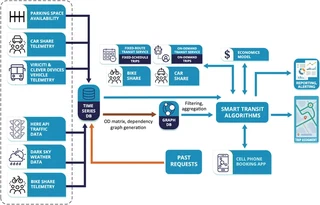
This project reimagines public transportation for mid-sized U.S. cities through an AI-driven, multi-modal mobility framework that integrates fixed-line buses and on-demand microtransit into a single, responsive system. Led by the Chattanooga Area Regional Transportation Authority (CARTA) with technical contribution from the Pennsylvania State University, Vanderbilt University, and Cornell University, this $7 million initiative is designed to enhance infrastructure utilization, mobility access, and financial viability of public transit in Chattanooga while providing a national model for AI-enabled mobility resilience.
At the project’s core is the concept of neighborhood mobility zones—virtual, data-driven operational areas that dynamically organize and optimize transportation resources without requiring costly new infrastructure. These zones centralize around Chattanooga’s downtown core, connecting neighborhoods, universities, hospitals, and economic centers. The system uses AI algorithms for real-time multi-modal routing, predictive demand modeling, and autonomy-aware fleet planning, ensuring that resources, human-driven and autonomous, are deployed where they are most effective.
Beyond technical innovation, the project establishes sustainable business models, such as subscription-based mobility packages and monetization of CARTA’s 4,200 parking spaces and other infrastructures, to ensure long-term economic viability.
By integrating multimodal mobility options, along with personal cars, the goal is to increase the overall trips served through the system by 5x. The project advances DOE’s Energy Efficient Mobility Systems (EEMS) objectives while aligning with the March 2025 Executive Order on “Achieving Efficiency Through State and Local Preparedness.” Overall it demonstrates how neurosymbolic AI and integrating autonomous technology with multimodal options can improve infrastructure reliability and effectiveness.
Team

Aron Laszka is an Associate Professor in the College of Information Sciences and Technology at the Pennsylvania State University. Previously, he was an Assistant Professor at the University of Houston, a Research Assistant Professor at Vanderbilt University, and a Postdoctoral Scholar at the University of California, Berkeley.
His research interests revolve around artificial intelligence and cyber-physical systems, focusing on machine learning for decision making and optimization, with applications in smart and connected communities, critical infrastructure, and cybersecurity.
His research is funded by the National Science Foundation, the Department of Energy, the Department of Transportation, and other agencies.
