Rural Transit Solutions for Enhancing Access & Connectivity
Funded in part by the National Science Foundation under Award CMMI-2431415 (2024 – 2025)


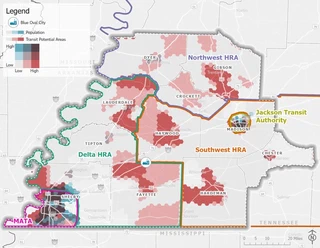
This Civic Innovation Challenge (CIVIC) Stage 1 project will perform research to address transportation challenges faced by residents and workers in rural areas around industrial hubs. Rapid economic growth in these areas demands efficient public transit systems that can serve a geographically dispersed workforce with strict arrival times. However, existing solutions often struggle with these unique requirements, leading to traffic congestion, pollution, and limited access to essential services for residents. This research project will develop and deploy a novel multi-modal transit system for Blue Oval City (BOC), a new rural industrial hub in Stanton, Tennessee. The system will combine fixed-line buses with on-demand micro-transit services, addressing the challenges posed by the geographically dispersed workforce and strict arrival times. Further, the project will design equitable fare structures to ensure that the system is sustainable for all stakeholders. If successful, the research will benefit communities around BOC by enhancing their access to employment opportunities, essential resources, and services, ultimately improving quality of life and community resilience. Furthermore, developing efficient and reliable transit can promote the growth of businesses in the surrounding areas and offer more affordable living options. The research findings and deliverables will be transferable to other rural industrial hubs across the nation, fostering economic development and improving public transportation infrastructure.
This project will be led by a multi-disciplinary, multi-stakeholder team of researchers and civic partners to co-create a scalable pilot project for BOC. The research project has two main goals. (i) Develop a system to optimize multi-modal transit networks, including micro-transit services that act as feeders for large, fixed-line buses. Models based on artificial intelligence will be designed to handle high volumes of employee trips and create service zones with optimal pick-up and drop-off locations, guaranteeing on-time arrivals for workers regardless of their shift schedules. (ii) Explore sustainable funding plans through stakeholder engagement, designing a fare structure that incentivizes ridership and ensures social equity. This includes examining how the system can improve access to healthcare, education, and other essential services.
Team

Aron Laszka is an Associate Professor in the College of Information Sciences and Technology at the Pennsylvania State University, where he directs the Applied Artificial Intelligence Lab. Before joining Penn State in 2022, he was an Assistant Professor at the University of Houston (2017 – 2022), a Research Assistant Professor at Vanderbilt University (2016 – 2017), and a Postdoctoral Scholar at the University of California, Berkeley (2015 – 2016).
His research focuses on machine learning for decision making and optimization, in particular reinforcement learning and learning-augmented combinatorial optimization, with applications in cyber-physical systems, such as transportation and power systems, and in cybersecurity. He is a recipient of the NSF CAREER Award. His research is funded by the National Science Foundation, the Department of Energy, the Department of Transportation, and other agencies.

