Aron Laszka

Aron Laszka

Associate Professor
Pennsylvania State University

Aron Laszka is an Associate Professor in the College of Information Sciences and Technology at the Pennsylvania State University. Previously, he was an Assistant Professor at the University of Houston, a Research Assistant Professor at Vanderbilt University, and a Postdoctoral Scholar at the University of California, Berkeley.

His research interests revolve around artificial intelligence and cyber-physical systems, focusing on machine learning for decision making and optimization, with applications in smart and connected communities, critical infrastructure, and cybersecurity.

His research is funded by the National Science Foundation, the Department of Energy, the Department of Transportation, and other agencies.

Safe and Private Forward-Trading Platform for Transactive Microgrids

Power grids are evolving at an unprecedented pace due to the rapid growth of distributed energy resources (DER) in communities. These resources are very different from traditional …

Scott Eisele
•

Data-Driven Decision Support for Optimizing Cyber Forensic Investigations

Cyber attacks consisting of several attack actions can present considerable challenge to forensic investigations. Consider the case where a cybersecurity breach is suspected …

Antonia Nisioti
•

The Role of Blockchains in Multi-Stakeholder Transactive Energy Systems

Power grids are undergoing major changes due to rapid growth in renewable energy and improvements in battery technology. Prompted by the increasing complexity of power systems, …

Scott Eisele
•
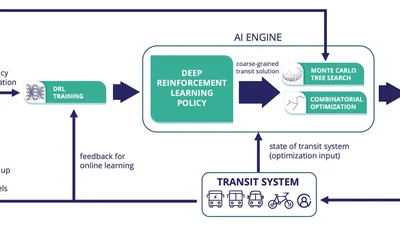
AI-Engine for Optimizing Mixed-Fleet Transit Operations featured image

AI-Engine for Optimizing Mixed-Fleet Transit Operations

In every public transit system, a trade-off has to be made between concentrating service into very useful routes that serve large numbers of people and spreading service out to ensure that people everywhere have access to at least some service. Improving the efficiency of an existing system while enhancing service in terms of both usefulness and coverage presents considerable challenges. These challenges to operational efficiency are exacerbated by the requirement to provide complementary paratransit services, which are typically characterized by very low efficiency (energy per passenger per mile) and attendant high cost of operation. Our vision is to address these challenges by combining the complementary advantages of fixed- and dynamic-route transit services and seamlessly integrating them. We focus on the following objectives: minimizing energy used per passenger per mile, minimizing passenger wait and trip times, maximizing service coverage, and maximizing the percentage of daily trips serviced by transit. To explore this complex decision space, we will design, implement, and evaluate an artificial intelligence engine, which will enable agencies with mixed-vehicle fleets (EVs, ICEVs, etc.) to operate integrated fixed-dynamic transit services that maximize energy efficiency and make transit more accessible.

Adversarial Deep Reinforcement Learning based Adaptive Moving Target Defense

Moving target defense (MTD) is a proactive defense approach that aims to thwart attacks by continuously changing the attack surface of a system (e.g., changing host or network …

avatar
Taha Eghtesad
•

Vyper: A Security Comparison with Solidity Based on Common Vulnerabilities

Vyper has been proposed as a new high-level language for Ethereum smart contract development due to numerous security vulnerabilities and attacks witnessed on contracts written in …

Mudabbir Kaleem
•

Graph-Theoretic Approach for Increasing Participation in Networks with Assorted Resources

In many cooperative networks, individuals participate actively as long as they recognize a sufficient value in participation, which depends not only on the number, but also on the …

Waseem Abbas
•

Equilibrium of Blockchain Miners with Dynamic Asset Allocation

We model and analyze blockchain miners who seek to maximize the compound return of their mining businesses. The analysis of the optimal strategies finds a new equilibrium point …

Go Yamamoto
•

Data-Driven Prediction of Route-Level Energy Use for Mixed-Vehicle Transit Fleets

Due to increasing concerns about environmental impact, operating costs, and energy security, public transit agencies are seeking to reduce their fuel use by employing electric …

avatar
Afiya Ayman
•

Blockchains for Transactive Energy Systems: Opportunities, Challenges, and Approaches

The emergence of blockchains and smart contracts have renewed interest in electrical cyber-physical systems, especially in the area of transactive energy systems. However, despite …

Scott Eisele
•