Aron Laszka

Aron Laszka

Associate Professor
Pennsylvania State University

Aron Laszka is an Associate Professor in the College of Information Sciences and Technology at the Pennsylvania State University. Previously, he was an Assistant Professor at the University of Houston, a Research Assistant Professor at Vanderbilt University, and a Postdoctoral Scholar at the University of California, Berkeley.

His research interests revolve around artificial intelligence and cyber-physical systems, focusing on machine learning for decision making and optimization, with applications in smart and connected communities, critical infrastructure, and cybersecurity.

His research is funded by the National Science Foundation, the Department of Energy, the Department of Transportation, and other agencies.

An End-to-End Solution for Public Transit Stationing and Dispatch Problem

Public bus transit systems provide critical transportation services for large sections of modern communities. On-time performance and maintaining the reliable quality of service is …

Jose Paolo Talusan
•
Fixed-Line Transit 2.0: Real-Time Optimization of High-Frequency Transit Service featured image

Fixed-Line Transit 2.0: Real-Time Optimization of High-Frequency Transit Service

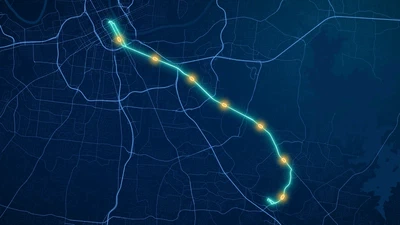
This project will develop and deploy a real-time, AI-driven decision support system that makes high-frequency bus service more reliable by anticipating and proactively mitigating delays, overcrowding, and service disruptions. Frequent, high-ridership bus routes are inherently unstable: when a bus falls behind, it encounters more waiting passengers and falls even further behind, until buses bunch together and leave long gaps in service, causing longer and less predictable waits, overcrowding, and missed transfers. The project focuses on WeGo Public Transit’s Route 55 Murfreesboro in Nashville, Tennessee, WeGo’s busiest route with nearly 5,000 weekday boardings, but also its least reliable one: more than 1 in 4 buses are either bunched or gapped, adding up to over 105 hours of excess waiting time for passengers every weekday.

Spotlight

Scalable Decision-Making in Stochastic Environments through Learned Temporal Abstraction

Sequential decision-making in high-dimensional continuous action spaces, particularly in stochastic environments, faces significant computational challenges. We explore this …

Baiting Luo
•
Rural Transit Solutions for Enhancing Access & Connectivity featured image

Rural Transit Solutions for Enhancing Access & Connectivity

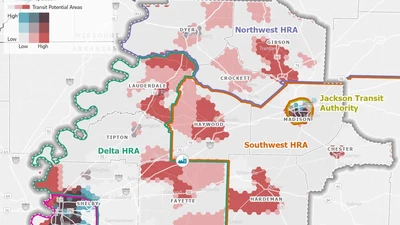
This Civic Innovation Challenge (CIVIC) Stage 1 project will perform research to address transportation challenges faced by residents and workers in rural areas around industrial hubs. Rapid economic growth in these areas demands efficient public transit systems that can serve a geographically dispersed workforce with strict arrival times. However, existing solutions often struggle with these unique requirements, leading to traffic congestion, pollution, and limited access to essential services for residents. This research project will develop and deploy a novel multi-modal transit system for Blue Oval City (BOC), a new rural industrial hub in Stanton, Tennessee. The system will combine fixed-line buses with on-demand micro-transit services, addressing the challenges posed by the geographically dispersed workforce and strict arrival times.

AI-Powered Autonomy-Aware Neighborhood Mobility Zones featured image

AI-Powered Autonomy-Aware Neighborhood Mobility Zones

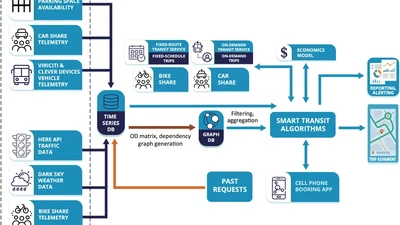
This project reimagines public transportation for mid-sized U.S. cities through an AI-driven, multi-modal mobility framework that integrates fixed-line buses and on-demand microtransit into a single, responsive system. Led by the Chattanooga Area Regional Transportation Authority (CARTA) with technical contribution from the Pennsylvania State University, Vanderbilt University, and Cornell University, this $7 million initiative is designed to enhance infrastructure utilization, mobility access, and financial viability of public transit in Chattanooga while providing a national model for AI-enabled mobility resilience.

Grid-Aware Charging and Operational Optimization for Mixed-Fleet Public Transit

The rapid growth of urban populations and the increasing need for sustainable transportation solutions have prompted a shift towards electric buses in public transit systems. …

Rishav Sen
•

SmartTransit.AI: A Dynamic Paratransit and Microtransit Application

New rideshare and shared mobility services have transformed urban mobility in recent years. Such services have the potential to improve efficiency and reduce costs by allowing …

Sophie Pavia
•

Deploying Mobility-On-Demand for All by Optimizing Paratransit Services

While on-demand ride-sharing services have become popular in recent years, traditional on-demand transit services cannot be used by everyone, e.g., wheelchair-bound people. …

Sophie Pavia
•

Multi-Agent Reinforcement Learning with Hierarchical Coordination for Emergency Responder Stationing

An emergency responder management (ERM) system dispatches responders, such as ambulances, when it receives requests for medical aid. ERM systems can also proactively reposition …

avatar
Amutheezan Sivagnanam
•

Multi-Agent Reinforcement Learning for Assessing False-Data Injection Attacks on Transportation Networks

The increasing reliance of drivers on navigation applications has made transportation networks more susceptible to data-manipulation attacks by malicious actors. Adversaries may …

avatar
Taha Eghtesad
•