Amutheezan Sivagnanam

Amutheezan Sivagnanam

Ph.D. 2025
Pennsylvania State University
Amutheezan joined the Applied Artificial Intelligence Lab as a Ph.D. student in fall 2019. His research interest is in Machine Learning and Data Science. Previously, he graduated with a Bachelors’s Degree in Computer Science and Engineering from the University of Moratuwa, Sri Lanka in 2017. He worked as an intern at WSO2 Lanka (PVT) Ltd., as part of the Data Analytics Team in 2016. He also worked as a software engineer in MillenniumIT Software PVT Ltd. from 2018 to 2019. He has previously worked on a machine learning project on semi-supervised based sentiment analysis of microblogging platforms and on a data analytics project on monitoring flows of HL7 messages. Currently, his research work focuses on optimizing bus-route scheduling and minimizing energy costs.
Machine Learning Data Science

Offline Vehicle Routing Problem with Online Bookings: A Novel Problem Formulation with Applications to Paratransit

Vehicle routing problems (VRPs) can be divided into two major categories: offline VRPs, which consider a given set of trip requests to be served, and online VRPs, which consider …

avatar
Amutheezan Sivagnanam
•

Data-Driven Prediction and Optimization of Energy Use for Transit Fleets of Electric and ICE Vehicles

Due to the high upfront cost of electric vehicles, many public transit agencies can afford only mixed fleets of internal-combustion and electric vehicles. Optimizing the operation …

avatar
Afiya Ayman
•

Minimizing Energy Use of Mixed-Fleet Public Transit for Fixed-Route Service

Affordable public transit services are crucial for communities since they enable residents to access employment, education, and other services. Unfortunately, transit services that …

avatar
Amutheezan Sivagnanam
•
AI-Engine for Optimizing Mixed-Fleet Transit Operations featured image

AI-Engine for Optimizing Mixed-Fleet Transit Operations

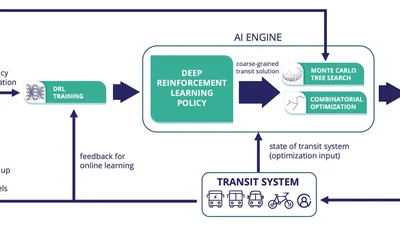
In every public transit system, a trade-off has to be made between concentrating service into very useful routes that serve large numbers of people and spreading service out to ensure that people everywhere have access to at least some service. Improving the efficiency of an existing system while enhancing service in terms of both usefulness and coverage presents considerable challenges. These challenges to operational efficiency are exacerbated by the requirement to provide complementary paratransit services, which are typically characterized by very low efficiency (energy per passenger per mile) and attendant high cost of operation. Our vision is to address these challenges by combining the complementary advantages of fixed- and dynamic-route transit services and seamlessly integrating them. We focus on the following objectives: minimizing energy used per passenger per mile, minimizing passenger wait and trip times, maximizing service coverage, and maximizing the percentage of daily trips serviced by transit. To explore this complex decision space, we will design, implement, and evaluate an artificial intelligence engine, which will enable agencies with mixed-vehicle fleets (EVs, ICEVs, etc.) to operate integrated fixed-dynamic transit services that maximize energy efficiency and make transit more accessible.

Data-Driven Prediction of Route-Level Energy Use for Mixed-Vehicle Transit Fleets

Due to increasing concerns about environmental impact, operating costs, and energy security, public transit agencies are seeking to reduce their fuel use by employing electric …

avatar
Afiya Ayman
•
Microtransit Solutions for Underserved Communities featured image

Microtransit Solutions for Underserved Communities

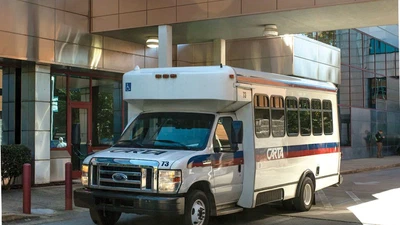
Public transportation infrastructure is an essential component in cultivating equitable communities. However, public transit agencies have historically struggled to achieve this since they are often severely stressed in terms of resources as they have to make the trade-off between concentrating service into routes that serve large numbers of people and spreading service out to ensure that people everywhere have access to at least some service. A solution that holds great promise for improving public transit systems is the integration of fixed-route services with microtransit systems: multi-passenger transportation services that serve passengers using dynamically generated routes and may expect passengers to make their way to and from common pick-up or drop-off points. However, most microtransit systems have failed in the past due to the lack of community engagement, inability to handle the uncertainty of operations when integrating the fixed transit, and inability to handle the system-level optimization challenges.

Addressing Transit Accessibility Challenges due to COVID-19 featured image

Addressing Transit Accessibility Challenges due to COVID-19

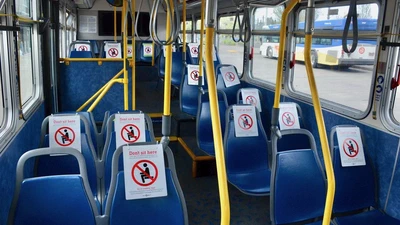
The COVID-19 pandemic has not only disrupted the lives of millions but also created exigent operational and scheduling challenges for public transit agencies. Agencies are struggling to maintain transit accessibility with reduced resources, changing ridership patterns, vehicle capacity constraints due to social distancing, and reduced services due to driver unavailability. A number of transit agencies have also begun to help the local food banks deliver food to shelters, which further strains the available resources if not planned optimally. At the same time, the lack of situational information is creating a challenge for riders who need to understand what seating is available on the vehicles to ensure sufficient distancing. In partnership with the transit agencies of Chattanooga, TN, and Nashville, TN, the proposed research will rapidly develop integrated transit operational optimization algorithms, which will provide proactive scheduling and allocation of vehicles to transit and cargo trips, considering exigent vehicle maintenance requirements (i.e., disinfection). A key component of the research is the design of privacy-preserving camera-based ridership detection methods that can help provide commuters with real-time information on available seats considering social-distancing constraints.

Efficient and Scalable Bug-Bounty Programs featured image

Efficient and Scalable Bug-Bounty Programs

Many organizations and companies have recently chosen to use so-called bug-bounty programs (also known as vulnerability reward programs), which allow outside security experts to evaluate the security of an organization’s products and services and to report security vulnerabilities in exchange for rewards. Bug-bounty programs provide unique benefits by allowing organizations to publicly signal their commitment to security and to harness the diverse expertise of thousands of security experts in an affordable way. Despite their rapidly growing popularity, bug-bounty programs are not well understood and can be mismanaged. As a result, bug bounty programs can waste substantial resources and they rarely live up to their potential to improve cybersecurity. This project will significantly improve the efficiency of bug-bounty programs by collecting and publishing comprehensive datasets on the bug-bounty ecosystem, by establishing a sound theory of bug-bounty programs, and by providing practical recommendations for organizations and regulators.

Data-Driven Energy Optimization for Multi-Modal Transit featured image

Data-Driven Energy Optimization for Multi-Modal Transit

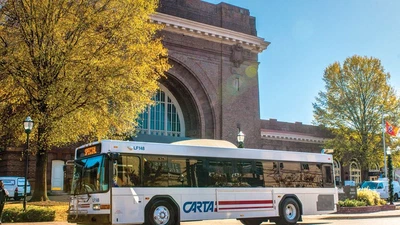
The goal of this project is to develop a high-resolution system-level data capture and analysis framework to revolutionize the operational planning of a regional transportation authority, specifically the Chattanooga Area Regional Transportation Authority (CARTA). There is existing research on improving energy efficiency in transportation networks through analyzing energy consumption data per vehicle type and driving context. However, these studies are based on trip-specific estimation and thus cannot be applied to a regional transportation network. Further, a number of these studies are based on simplified model estimation that is used within a simulation framework for analysis and are therefore difficult to validate during actual driving/road conditions that are not captured in the training dataset (which is typically limited in size and features).