Afiya Ayman

Afiya Ayman

Ph.D. 2025
Pennsylvania State University
Afiya Ayman joined the Applied Artificial Intelligence Lab as a Ph.D. student in January 2019. Her research interest is in contemporary computational sciences, including and not limited to Data Science, Machine Learning, and Cyber Security. She earned her bachelor’s degree in Computer Science & Engineering from Chittagong University of Engineering & Technology, Bangladesh. Currently, her research focuses on the application of neural networks and machine learning to restructure the operational planning of a regional transportation authority to be more energy-efficient.
Data Science Machine Learning Cybersecurity

Ensemble Prediction of Task Affinity for Efficient Multi-Task Learning

A fundamental problem in multi-task learning (MTL) is identifying groups of tasks that should be learned together. Since training MTL models for all possible combinations of tasks …

avatar
Afiya Ayman
•

AI for Smart Transportation

Public transportation systems worldwide face persistent challenges of efficiency, reliability, and sustainability. In this chapter, we explore how AI-powered approaches can …

Michael Wilbur
•
Rural Transit Solutions for Enhancing Access & Connectivity featured image

Rural Transit Solutions for Enhancing Access & Connectivity

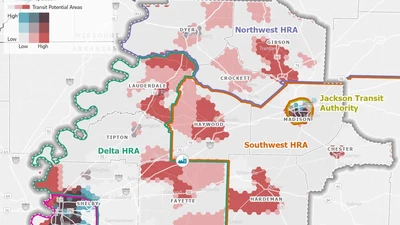
This Civic Innovation Challenge (CIVIC) Stage 1 project will perform research to address transportation challenges faced by residents and workers in rural areas around industrial hubs. Rapid economic growth in these areas demands efficient public transit systems that can serve a geographically dispersed workforce with strict arrival times. However, existing solutions often struggle with these unique requirements, leading to traffic congestion, pollution, and limited access to essential services for residents. This research project will develop and deploy a novel multi-modal transit system for Blue Oval City (BOC), a new rural industrial hub in Stanton, Tennessee. The system will combine fixed-line buses with on-demand micro-transit services, addressing the challenges posed by the geographically dispersed workforce and strict arrival times.

The Benefits of Vulnerability Discovery and Bug Bounty Programs: Case Studies of Chromium and Firefox

Recently, bug-bounty programs have gained popularity and become a significant part of the security culture of many organizations. Bug-bounty programs enable organizations to …

avatar
Soodeh Atefi
•

Impact of COVID-19 on Public Transit Accessibility and Ridership

COVID-19 has radically transformed urban travel behavior throughout the world. Agencies have had to provide adequate service while navigating a rapidly changing environment with …

Michael Wilbur
•

Neural Architecture and Feature Search for Predicting the Ridership of Public Transportation Routes

Accurately predicting the ridership of public-transit routes provides substantial benefits to both transit agencies, who can dispatch additional vehicles proactively before the …

avatar
Afiya Ayman
•

Data-Driven Prediction and Optimization of Energy Use for Transit Fleets of Electric and ICE Vehicles

Due to the high upfront cost of electric vehicles, many public transit agencies can afford only mixed fleets of internal-combustion and electric vehicles. Optimizing the operation …

avatar
Afiya Ayman
•

Minimizing Energy Use of Mixed-Fleet Public Transit for Fixed-Route Service

Affordable public transit services are crucial for communities since they enable residents to access employment, education, and other services. Unfortunately, transit services that …

avatar
Amutheezan Sivagnanam
•
AI-Engine for Optimizing Mixed-Fleet Transit Operations featured image

AI-Engine for Optimizing Mixed-Fleet Transit Operations

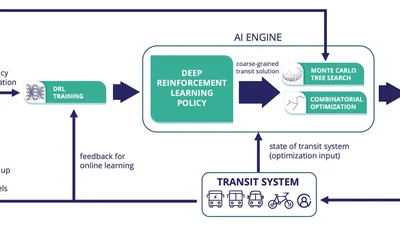
In every public transit system, a trade-off has to be made between concentrating service into very useful routes that serve large numbers of people and spreading service out to ensure that people everywhere have access to at least some service. Improving the efficiency of an existing system while enhancing service in terms of both usefulness and coverage presents considerable challenges. These challenges to operational efficiency are exacerbated by the requirement to provide complementary paratransit services, which are typically characterized by very low efficiency (energy per passenger per mile) and attendant high cost of operation. Our vision is to address these challenges by combining the complementary advantages of fixed- and dynamic-route transit services and seamlessly integrating them. We focus on the following objectives: minimizing energy used per passenger per mile, minimizing passenger wait and trip times, maximizing service coverage, and maximizing the percentage of daily trips serviced by transit. To explore this complex decision space, we will design, implement, and evaluate an artificial intelligence engine, which will enable agencies with mixed-vehicle fleets (EVs, ICEVs, etc.) to operate integrated fixed-dynamic transit services that maximize energy efficiency and make transit more accessible.

Data-Driven Prediction of Route-Level Energy Use for Mixed-Vehicle Transit Fleets

Due to increasing concerns about environmental impact, operating costs, and energy security, public transit agencies are seeking to reduce their fuel use by employing electric …

avatar
Afiya Ayman
•